
By Shaina Hayutin, Coach at CrossFit Newtown
If you’re reading this, you’ve probably heard the term “scaling” on a regular basis. Do you fully understand what it means though? Let’s pause for a second and think.
Seriously, take a moment….
Perhaps similar words pop into your brain like modification or progression? Maybe you think scaling is a safe and smart way to approach your workout? Some may find themselves responding “oh well, I just scaled,” after a coach approaches you with a well-deserved and fist bump. Before assuming, let’s make sure we have a full and comprehensive understanding of what “scaling” actually means.
Scaling is simply an appropriately challenging, intelligent way to approach your workout.
It does not mean lesser than.
It does not mean easier.
It does not mean you didn’t work as hard as the person next to you who Rx’d.
It means finding the right amount of intensity in order for YOU to get as close to the intended stimulus for the day.
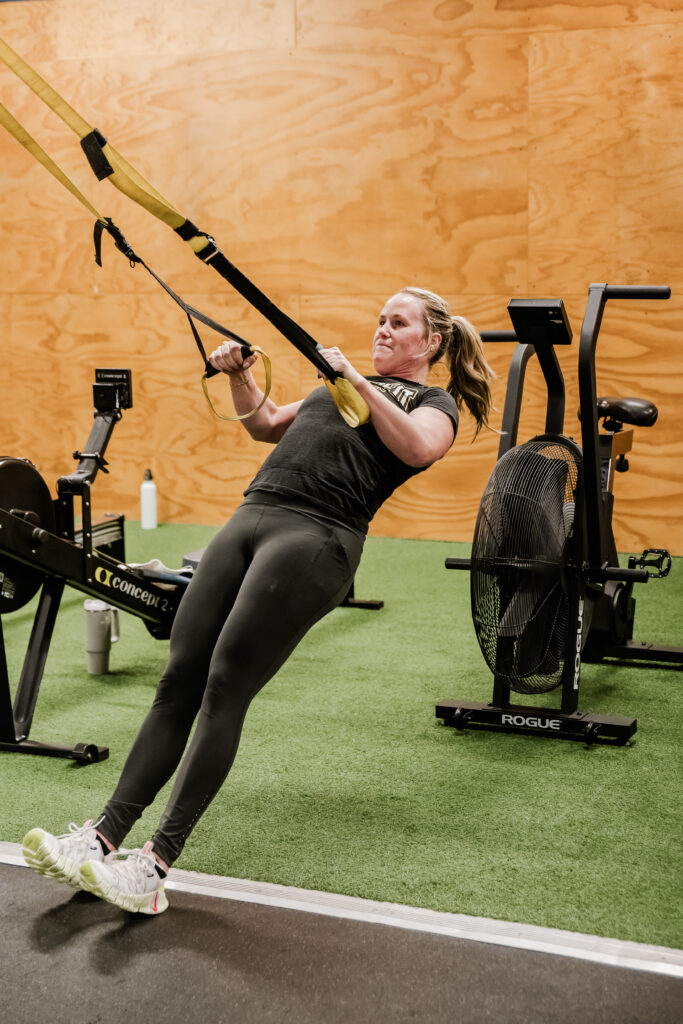
Scaling is a joint effort between the coach and the athlete. It is the coaches job to educate the athlete to learn how to scale intelligently. And it’s the athletes’ job to absorb that information in order to create a higher level of body and self awareness. It can be a beautiful, mutual relationship.
There are four factors to consider when scaling: [CrossFit online Scaling Course]
- Experience Level
- Beginner/Deconditioned Athlete
- Intermediate/Novice CrossFit Athlete
- Former Athlete/ Minimal CrossFit Experience
- Advanced CrossFit Athlete
- Injured Athlete
- Technical Proficiency
- Level of Fatigue
- Injury Status
Not everyone will fit perfectly under those categories of experience level, our technique is hopefully always on a path of improvement, our degree of fatigue will vary day to day, and our injury status will depend.
Now, let’s step back from this for a second and simply think about the word “scale.” A scale is a tool used to define a form of measurement. We understand that those measurements can go up and down. That’s why this word “scaling” was intentionally chosen when the CrossFit methodology first came about back in 2000. It is specifically meant to help guide athletes regarding how they can approach their workouts, because an athlete can scale a workout down or up. It goes both ways.
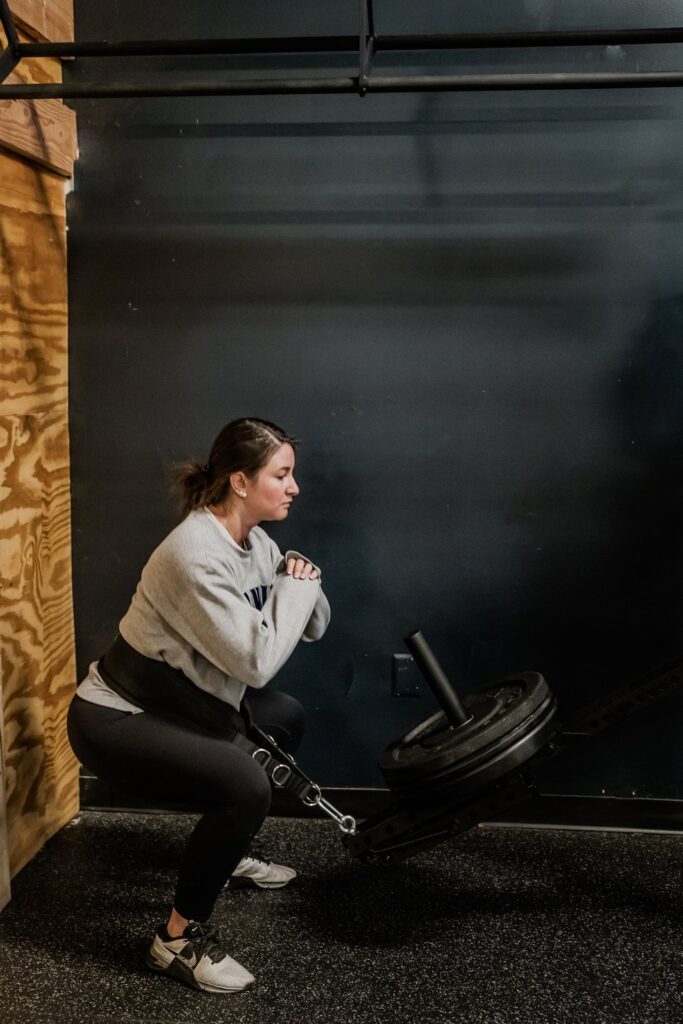
Scaling does not simply apply to the movement itself, but can also apply to changing the rep scheme or time domain accordingly as well. It also does not have to be a perfect 1:1 ratio where one movement is swapped for one different movement. For example, if a kipping handstand push up is prescribed for the day, an athlete can choose to complete a handstand hold plus a push up instead. This is also a great example of what we call a “progression.”
A progression is a movement, or series of movements, used to get you on the right path towards a higher level skill. It could be as simple as completing a full squat clean with a PVC pipe, with the goal of one day squat cleaning fifty percent of your body weight. It could be more ambiguous like doing hollow banded lat pull downs plus pull up bar dips to one day gain the strength to get a bar muscle up. A progression gets you on the proper path to achieve that higher level skill.
Frequently, we also hear “modification.” Modification is a more general term that means we are substituting one part of the workout for something else. We are not trying to find a substitute that perfectly utilizes the same musculature, and we may have to compromise the intended stimulus. We are simply finding a way for the athlete to move as safely as possible.
Modifications are usually used due to an injury, fatigue, or high stress levels. An example would be an athlete who has low back pain and cannot complete kettlebell swings for the workout. Instead, we could do a weighted glute bridge. We are still getting hip extension and posterior chain engagement, as well as weight training. However, we are eliminating some of the cardiovascular benefits we receive from doing a kettlebell swing, and simplifying the movement by bringing it to the floor. A modification does not account for trying to eventually obtain a high level skill. That’s what distinguishes a modification from a progression.
Having an understanding of the differences between these terms is vital to an athlete’s ability to take ownership over their own fitness progress. Yes, the coach is there to help guide them to make the best possible choices they can each and every day they train. Personal responsibility has to play a role as well. An athlete must show up willing to learn and try hard. Together, we can make sure you maintain variety as well.
The CrossFit online Scaling Course says, “Routine or stagnant scaling of specific elements is a missed opportunity to improve an athlete’s fitness. There is no universal approach that will be appropriate in all situations. Therefore, the best practice is one of flexibility and willingness to adjust based on an athlete’s needs.” Thus, variety within your scaling options is imperative. When you feel stuck, the coach is there to help provide that variety. When you think you may have plateaued, the coach is there to help you find appropriate progressions. And if you are tired or injured, the coach is there once again to keep you moving. Your coach is always there for you. All you need to do is show up and be willing to try different things, because when implemented appropriately, scaling is pretty cool.
Shaina Hayutin is a CrossFit Coach and Content writer at CrossFit Newtown in Newtown, PA. With a Degree in Journalism, a Level 2 CrossFit Coach, a Healthy Steps Nutrition Coach, and over a decade of experience in the fitness industry, she emphasizes the critical role that community plays in achieving optimal fitness results while maintaining long-term health and wellness.